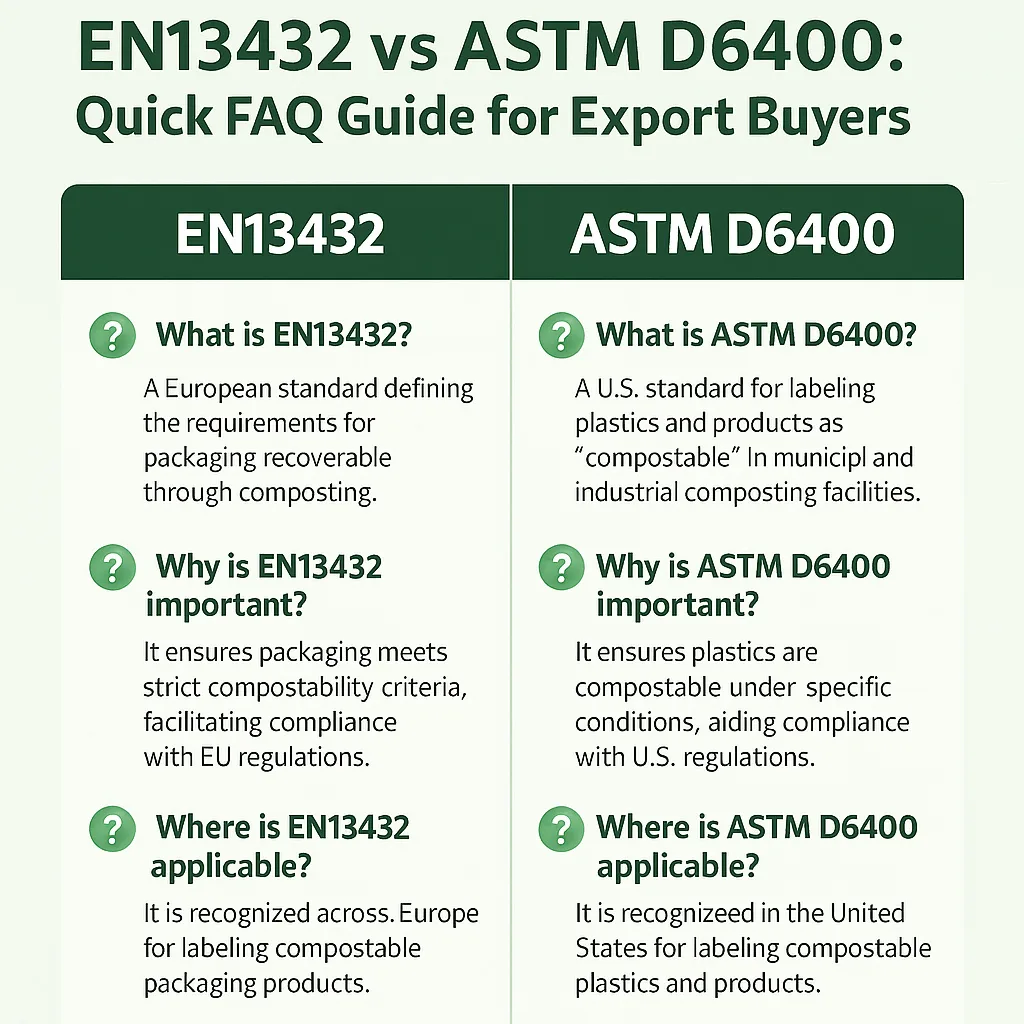
EN13432 and ASTM D6400 are equivalent industrial compostability standards—EN13432 applies in Europe, ASTM D6400 in North America. Both require at least 90% biodegradation within 180 days, full disintegration, and eco-safety. EN13432 certifications come from TÜV Austria or DIN CERTCO; ASTM D6400 often comes with BPI certification. For export compliance, brands must carry the appropriate mark and register in EPR systems like LUCID (Germany) or Triman (France), or conform with U.S. regulations to avoid customs delays and greenwashing claims.
As global plastic bans tighten and green compliance becomes essential for market access, understanding compostability standards like EN13432 and ASTM D6400 is no longer optional—it’s mission-critical. For export buyers, especially in the food packaging industry, navigating these certifications can determine whether your biodegradable products can legally enter European or North American markets.
This guide decodes the differences, legal requirements, and practical steps between EN13432 and ASTM D6400 in an export-ready FAQ format. Whether sourcing compostable packaging or planning global distribution, this article will help you make informed, regulation-compliant decisions.
How to Import from China in 2025: Comprehensive Step-by-Step Guide
What Is EN13432?
EN13432 is the European Union’s harmonized standard defining whether packaging materials are industrially compostable.
 |
OK Compost Lable

Key criteria:
Minimum 90% biodegradation within 6 months under controlled composting conditions.
Disintegration into fragments <2 mm within 12 weeks.
No toxic residue; must pass heavy metal and ecotoxicity tests.
Requires final product—not just material—testing.
 |  |
Why it matters for exporters:
EN13432 certification is legally required for products marketed as “compostable” in the EU under the Packaging and Packaging Waste Directive 94/62/EC. Without it, products can be rejected at customs or banned from sale.
What Is ASTM D6400?
ASTM D6400 is the North American standard (especially in the U.S. and Canada) used to evaluate compostable plastics and packaging materials.
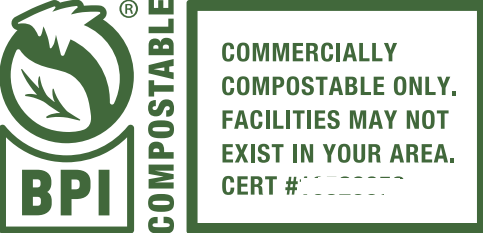
Core benchmarks:
Biodegradation ≥90% in 180 days in an industrial compost facility.
Physical disintegration within 84 days.
Must not inhibit plant growth or release heavy metals.
Applies to finished items, not raw material alone.
 |  |
Why it’s critical:
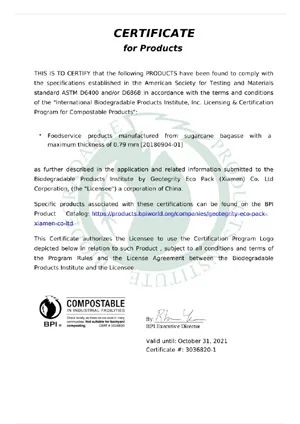
Many U.S. municipalities require ASTM D6400 compliance before allowing packaging into organic waste streams. It’s also a prerequisite for third-party logos such as the BPI Certification in the U.S.
EN13432 vs ASTM D6400: What’s the Difference?
| Aspect | EN13432 (EU) | ASTM D6400 (U.S./Canada) |
|---|---|---|
| Scope | Packaging only | Broader: packaging + plastics |
| Region | European Union | North America |
| Biodegradation Timeline | 6 months | 6 months |
| Testing | Per final product | Per final product |
| Ecotoxicity | Required | Required |
| Legal Backing | Required by EU law | Required by local/state law |
| Labeling | EN13432 logo or TÜV Austria | BPI logo or ASTM mark |
👉 Bottom Line: Both are rigorous compostability standards, but tied to different legal systems. Products aiming for global distribution should ideally comply with both.
Do You Need Both Certifications for Export?
Yes, if you’re selling into both Europe and North America.
For example:
A bagasse takeaway container marketed in Germany must meet EN13432.
The same product shipped to California or New York must meet ASTM D6400 and be BPI-certified to avoid greenwashing claims and legal penalties.
Even if your raw material is certified, your final product (e.g., coated paper bowls, PLA cups) must also be certified for the intended market.
What Materials Can Be Certified?
| Material Type | Certifiable Under EN13432? | Certifiable Under ASTM D6400? |
|---|---|---|
| PLA (Polylactic Acid) | ✅ | ✅ |
| Bagasse (sugarcane fiber) | ✅ | ✅ |
| Coated Paperboard (with compostable lining) | ✅ (if tested as whole) | ✅ |
| Oxo-degradable Plastic | ❌ | ❌ |
| Petroleum-Based Plastic | ❌ | ❌ |
Only bio-based or compostable polymers and fibers can meet either standard. Oxo-degradable or bio-blended plastics generally do not qualify.
Can You Self-Declare Compliance?
No. Both standards require third-party certification.
For EN13432: Recognized bodies include TÜV Austria, DIN CERTCO (Germany), and AIB Vincotte.
For ASTM D6400: Most reputable in the U.S. is the Biodegradable Products Institute (BPI).
Failure to certify through an accredited body can result in:
Customs seizure
Mislabeling fines
Product bans or delisting
Damage to brand trust
Is Home Composting Covered?
No. EN13432 and ASTM D6400 are for industrial composting.
If you want home composting recognition:
In the EU: Get “OK Compost Home” from TÜV Austria.
In Australia: AS5810 is the standard for home compostables.
In U.S.: No nationally accepted home composting standard exists (yet).
How Do These Standards Support Plastic Bans?
Governments and municipalities are increasingly referencing EN13432 and ASTM D6400 in their legislation to regulate what can be labeled “compostable” or disposed of with organic waste.
Example:
France bans plastic-like bioplastics unless they are EN13432-certified.
California requires ASTM D6400 + BPI certification for use of the term “compostable.”
These standards offer a clear, science-based pathway for businesses to legally market sustainable alternatives.
Bioleader Case Study: Dual-Certified Tableware for Global Export
🌱 Company: Bioleader®
🌍 Markets: Europe, U.S., Middle East, Southeast Asia
📦 Products: Bagasse bowls, PLA cups, kraft paper containers
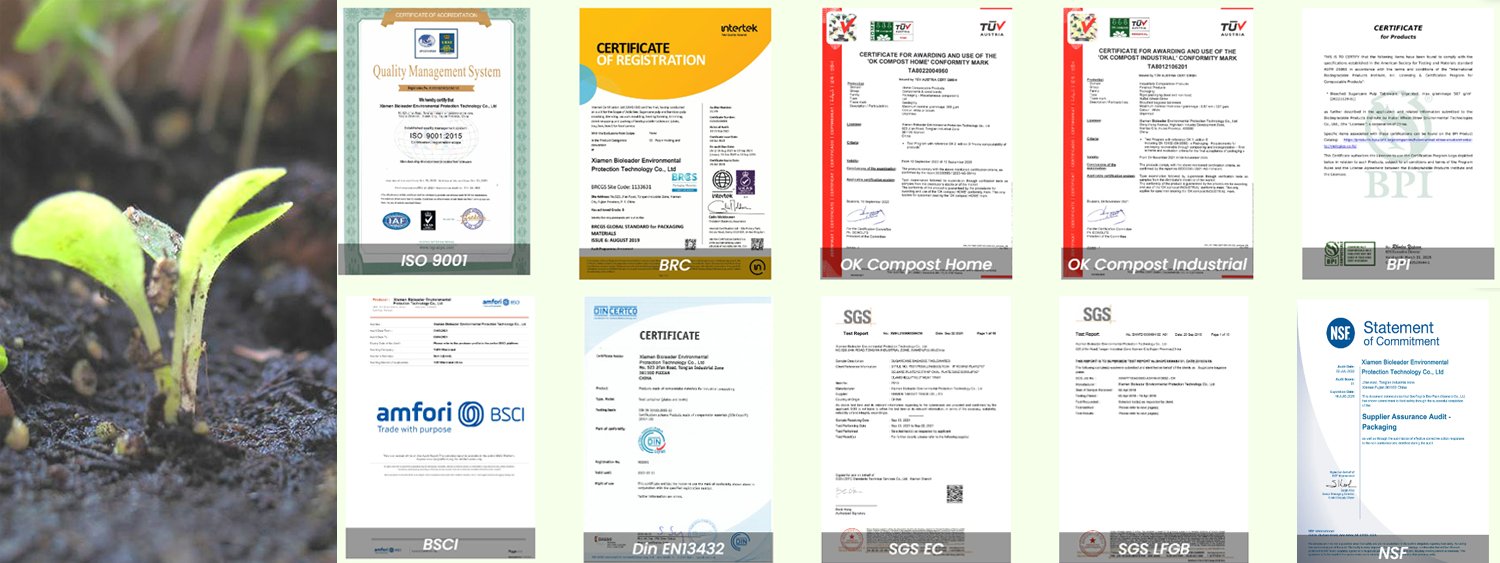
✅ Certifications: EN13432 (via DIN CERTCO), ASTM D6400 (BPI), FDA food contact
Challenge:
A European distributor requested 10,000 compostable bagasse clamshells for municipal supply contracts in Germany, requiring EN13432. Meanwhile, a U.S. buyer needed ASTM D6400 certification for state compliance in Oregon and Colorado.
Solution:
Bioleader adapted its manufacturing process to meet both standards and provided dual certificates on the final packaged product, enabling smooth customs clearance and contract approvals.
Result:
Bioleader increased B2B exports by 31% over 12 months and built long-term partnerships across multiple compliance zones.
Expert Quote
“For food packaging exports in 2025, EN13432 and ASTM D6400 aren’t just certifications—they’re passports to access regulated green markets. Without them, you risk product rejection and reputational damage.”
— Dr. Karen Li, Circular Materials Advisor, EU Plastics Compliance Taskforce
Final Takeaways
✅ If you’re exporting compostable food packaging, you must certify under the relevant regional standard.
✅ EN13432 is essential for EU markets. ASTM D6400 is mandatory for U.S./Canada.
✅ Dual certification enables seamless global trade and avoids legal pitfalls.
✅ Partner with certified manufacturers like Bioleader who understand both regulatory frameworks.
📌 FAQ Section(People Also Ask)
1. What is the difference between EN13432 and ASTM D6400?
EN13432 is the European compostability standard focused on packaging, while ASTM D6400 is the North American equivalent covering plastics and packaging. Both require full product testing and biodegradation within six months, but apply to different markets and regulatory systems.
2. Is EN13432 required for selling in Europe?
Yes. Under the EU Packaging Waste Directive, any packaging product labeled “compostable” must be EN13432 certified. Without this certification, your product may be blocked at customs or legally restricted in EU countries.
3. Does ASTM D6400 cover home composting?
No. ASTM D6400 only applies to industrial composting environments. For home composting, certifications like TÜV OK Compost Home (EU) or AS 5810 (Australia) are required.
4. Can you use “compostable” labels without certification?
No. Both the EU and U.S. have strict regulations on compostability claims. Using the term “compostable” without valid third-party certification (EN13432, ASTM D6400) may lead to fines, bans, or product recalls.
5. What are the best materials to meet both standards?
Materials like PLA, bagasse, and uncoated paper fiber can meet both EN13432 and ASTM D6400 standards when processed properly. Mixed materials (e.g., plastic blends, oxo-degradables) typically do not qualify.
How EN13432 & ASTM D6400 Differ—and What Exporters Should Do
What they are: Both EN13432 and ASTM D6400 certify that products are industrially compostable—biodegrading ≥90% in 180 days and disintegrating into safe compost without toxic residues.
Regional scope: EN13432 is required in Europe and many Asian markets; ASTM D6400 is the recognized standard in the U.S. and Canada.
Certification bodies: EN13432 is issued by TÜV Austria or DIN CERTCO; ASTM D6400 is backed by BPI certification in North America.
Why it matters for exports: Using correct certification ensures legal labeling and avoids customs holds. Growing EPR systems (e.g. Germany’s LUCID, France’s Triman, upcoming U.S. state mandates) require proper documentation and registration.
Options for brands: Obtain both certifications to ensure multi-market access, include QR-linked digital compliance credentials on packaging, and register proactively in EPR frameworks to future-proof supply chains.